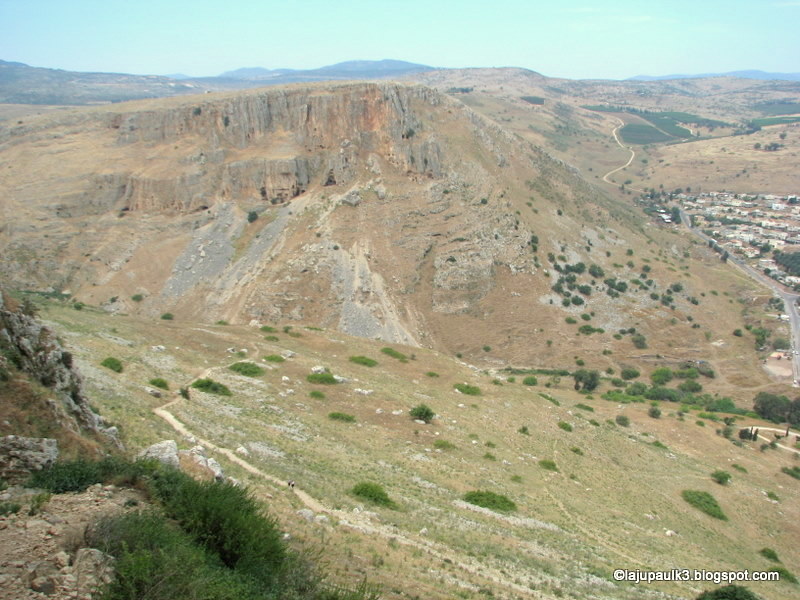
1. Mount Azmon (547 M); 2. Mount Ahim (521 M); 3. Mount Avtalyon (424 M); 4. Eilabun-A Christian Israeli Arab Settlement; 5. Hararit-A Jewish Communal Settlement (1980); 6. Massad-A Jewish Communal Settlement (1983); 7. Deir Hanna-An Israeli Arab Settlement. Believed to be the site of the Jewish village of Kfar Yohanna, the seat of the Priestly Courses of Yakhin ( the 21st of the 24 Priestly Courses) ; 8. Lotem-A Kibbutz from 1978.
"And he began again to teach by the sea side: and there was gathered unto him a great multitude, so that he entered into a ship, and sat in the sea; and the whole multitude was by the sea on the land. And he taught them many things by parables, and said unto them in his doctrine. Hearken; Behold, there went out a sower to sow: (Mark 4:1-3)".
The special acoustics of the area has been researched by B. Cobbey Crisler and according to him around 5000-7000 can assemble here and can still be audible by a person speaking from the cove (published Biblical Archaeologist, 1976 issue; 39 (4): 128-141). I suggest you to go through 'BiblePlaces.com' for great pictures of the site and to hear an audio file recorded.
Four excavation seasons have been carried out at the site till date (2007 to 2011). The major findings include
1) A 14.5 meters wide Synagogue from late 3rd or early 4th century AD
2) Massive Residential Complexes and an Oil Press from at least 2nd century AD
3) Weapons and a hoard of coins from the days of Hadrian Caesar (2nd century AD)
4) Beautiful mosaic fragments depicting scenes that have no parallels neither in other synagogues, nor in Roman-Byzantine art in Israel at all.
More details and pictures can be fetched from the official Hebrew University site below:
For some it is the venue where Jesus had his famous 'Sermon on the Mountain' (Mount of Beatitudes'-Mathew 5:1-2, Luke 6:17-21; 7:1). The site has also been identified with various biblical cities like Madon (Joshua 11:1), Adamah (Joshua 19:32-36) and the 'Waters of Merom' (Joshua 11:5-9). For the Druze community, at the base of the hill is the traditional tomb of their revered prophet Jethro (Nebi Shuaib), and the father-in-law of Moses (Exodus 3:1).