Experience the most vibrant,amazing yet unpredictable strip of land on earth.
Monday, October 29, 2012
Saturday, September 22, 2012
Saturday, August 25, 2012
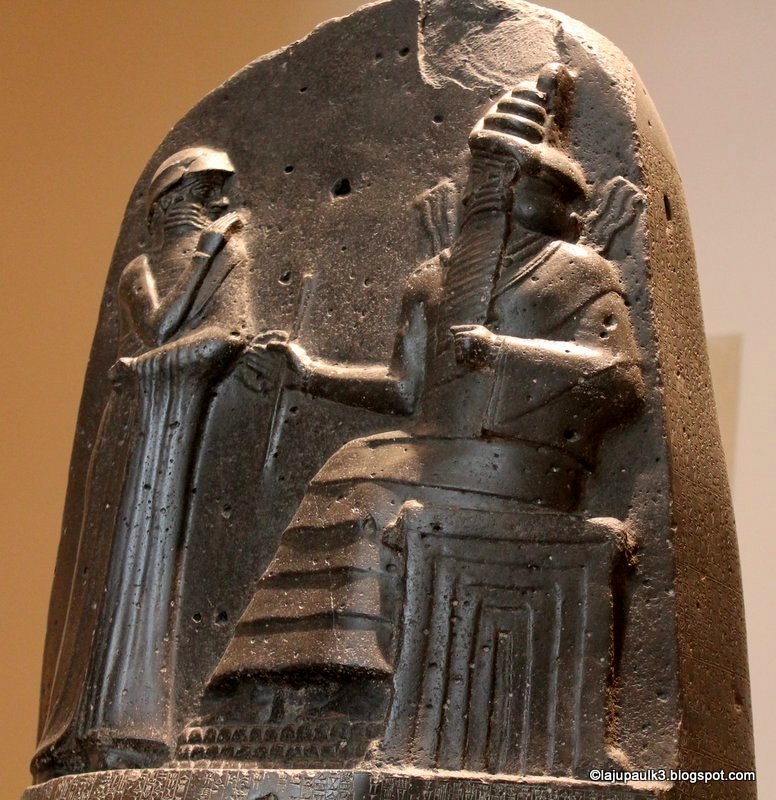
The Code of Hammurabi (1772 BC)-one of the earliest code of laws discovered. Displayed in the Louvre Museum of Paris, France.
One of the oldest deciphered writings of
significant length, the Code of Hammurabi is the longest surviving legal text
from the Old Babylonian period. Although Hammurabi's Code is not the oldest
code of laws in the world, it is the best preserved legal document from the ancient
Near East. The code was issued by Hammurabi, the 6th King of ancient
Babylon who ruled for 42 years from 1792 to 1750 BC. The almost complete code
survives today on a 7.4 ft tall shining black diorite stele in the shape of a
huge index finger. A total 282 laws, carved in 49 columns and 28 paragraphs in ancient
Akkadian language, the code deals mainly on civil, criminal, and family matters
of the Babylonian society. The stele was
discovered from ancient Susa, Elam (modern Khūzestān in Iran) by French archaeologists
in 1901 and currently on display in the Louvre Museum of Paris, France. Here is
a link to an English translation of the complete Hammurabi Code.
The discovery of the Hammurabi Code is important for
Biblical studies as it supports the authenticity of the Law of Moses. The
similarities between the Code of Hammurabi and the Law of Moses are so much,
some even hypothesize that Hammurabi influenced Moses while writing the Torah. The closest parallel comes
in the common wording of "eye for an eye" and "tooth for a
tooth" (Hammurabi Code 196, 197, 200 and Exodus 21:23-25). Although there
are certainly similarities, there are also many differences. Mosaic Law is based
in the worship of one God and involves spiritual principles, whereas Hammurabi
Code is mainly civil and criminal. The Hammurabi Code written at least three
centuries before Moses (1500-1400 BC) is also an answer for Bible critics who believed
that Moses could not have written the first five books of the Old Testament
because the art of writing was not developed until well after his death.
Monday, July 16, 2012
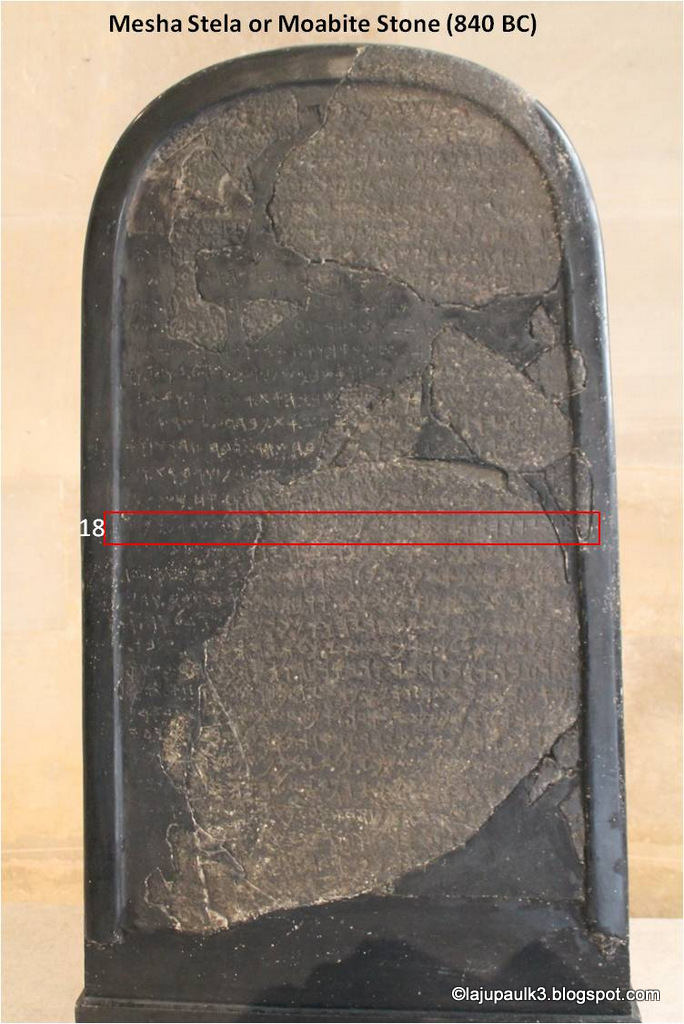
"Mesha Stele" or "Moabite Stone" (9th Century BC), Louvre Museum, Paris. Considered as one of the oldest inscription where the sacred name "Yahweh" (YHWH) is used in written form. The name 'Israel' is mentioned 6 times in this stele from 840 BC.
"The Mesha Stele" or the "Moabite Stone" was by erected by the Biblical King "Mesha", king of Moab, at Dhiban (in modern Jordan) around 840 BC. Scribbled on a three feet tall black basalt rock in Moabite language (very similar to ancient Hebrew), the 34-lined Mesha Stele is one of the longest monumental inscriptions ever found from Israel-Palestine region.
"And Mesha king of Moab was a sheepmaster, and rendered unto the king of Israel an hundred thousand lambs, and an hundred thousand rams, with the wool.But it came to pass, when Ahab was dead, that the king of Moab rebelled against the king of Israel"( 2 Kings 3:4-5).
Mesha stele is an important discovery in the field of Biblical archaeology due to a couple of reasons. It is the first non-biblical text (and one of the oldest too) or inscription found in modern times using “Yahweh” (YHWH, or Jehovah), as a name for the God of Israel. The name “Israel” is mentioned six times on the stele. It also names Israel’s sixth king Omri and refers to his sons as well. Some identify the stele containing the earliest mention of the "House of David". In addition, the stone validates many places mentioned in the Bible.
The stele was discovered in 1868, in Dhiban (biblical Dibon) by the German missionary F.A. Klein.In 1873,the local Bedouins smashed the stone into pieces, assuming that it contained a treasure after they saw the great interest it aroused among Europeans. They broke the stele into several fragments, burned it and poured water on it. How unfortunate it is after surviving nature's harshness for about 2500 years, this historic inscription meets such a tragic fate in greedy human hands.
Luckily, with the help of an impression of the Stone made by a young Frenchman named Charles Clermont-Ganneau before it was broken, archaeologists were able to reconstruct about two-thirds of the texts inscribed on the stone (613 of the estimated 1000 letters). Around 60 fragments were recovered (38 purchased by Clermont-Ganneau himself) and the stele was reconstructed in Paris. Since 1875, it has been displayed in Louvre Museum, paris.
In the 18th line of the inscription appear the Sacred name, "Yahweh" and the word "Israel". Look for the words in the enlarged snap.
Mesha stele is an important discovery in the field of Biblical archaeology due to a couple of reasons. It is the first non-biblical text (and one of the oldest too) or inscription found in modern times using “Yahweh” (YHWH, or Jehovah), as a name for the God of Israel. The name “Israel” is mentioned six times on the stele. It also names Israel’s sixth king Omri and refers to his sons as well. Some identify the stele containing the earliest mention of the "House of David". In addition, the stone validates many places mentioned in the Bible.
The stele was discovered in 1868, in Dhiban (biblical Dibon) by the German missionary F.A. Klein.In 1873,the local Bedouins smashed the stone into pieces, assuming that it contained a treasure after they saw the great interest it aroused among Europeans. They broke the stele into several fragments, burned it and poured water on it. How unfortunate it is after surviving nature's harshness for about 2500 years, this historic inscription meets such a tragic fate in greedy human hands.
Luckily, with the help of an impression of the Stone made by a young Frenchman named Charles Clermont-Ganneau before it was broken, archaeologists were able to reconstruct about two-thirds of the texts inscribed on the stone (613 of the estimated 1000 letters). Around 60 fragments were recovered (38 purchased by Clermont-Ganneau himself) and the stele was reconstructed in Paris. Since 1875, it has been displayed in Louvre Museum, paris.
In the 18th line of the inscription appear the Sacred name, "Yahweh" and the word "Israel". Look for the words in the enlarged snap.
Saturday, June 16, 2012
Friday, May 18, 2012
Saturday, April 21, 2012
Sunday, April 1, 2012
PALM SUNDAY-Triumphal entry of Jesus from Beth Phage to Jerusalem.
And they brought the colt to Jesus, and cast their garments on him; and he sat upon him. And many spread their garments in the way: and others cut down branches off the trees, and strawed [them] in the way. And they that went before, and they that followed, cried, saying, Hosanna; Blessed [is] he that cometh in the name of the Lord: Blessed [be] the kingdom of our father David, that cometh in the name of the Lord: Hosanna in the highest (Mark 11:7-10).
Fresco from the Catholic Church at Beth Phage
The Crusader Stone marks the spot where Jesus' journey began.
(Photos from blog archives, November-2009)
Subscribe to:
Posts (Atom)