Friday, March 1, 2013

WISH I HAD BEEN THERE, BUT COULDN'T!

In my last post, I discussed about the sites in Jerusalem that I couldn’t access due to mainly unavoidable reasons. If I am to pick 20 sites now, I would go for the following (but not in any specific order).


1) Interior of the 'Dome of the Rock’ (Foundation stone) and Al-Aqsa Mosque (Solomon Stables)-The Temple Mount. (Only Muslims are allowed)

2) The Armenian Chapel of St. Vartan (4th century Christian art)-The Church of Holy Sepulcher (Requires special permission from Armenian Patriarchate)

3) The Burnt House of Jewish Quarter from Second Temple Period (Photography not allowed)

4) The Hurva Synagogue (18th Century) after renovation

5) The Belz Great Synagogue (largest synagogue in the world)

6) The 1st Century Tomb of Kings/Queen Helena of Adiabene (one of the largest and beautiful tombs in Jerusalem)-was very difficult to even reach the caretakers, forget permission!

7) Jason's Tomb from Maccabean Period, 2nd century BC (open only on Mondays and Thursdays for a few hours)

8) Hosanna Stone, Armenian Quarter (see Luke 19:40). Access restricted to non-Armenians.

9) The Armenian Bird Mosaic, near the Damascus Gate (5th-6th century AD)-I was unable to locate.

10) The 1st Century Channel connecting Siloam Pool and the Jerusalem Archaeological Park (was not open to public when I was in Israel)

11) The ‘Quarry of Herod’ near Ramat Shlomo (supplied the giant stones for the building of the Temple Mount)-not sure if it is open to the public.

12) The Armenian church St. Saviour (the house of Caiaphas), Mount Zion (courtyard with beautiful blue Armenian ceramics)-no access for public at least when I was in Israel.

13) The Greek Orthodox Church St. John the Baptist, Christian Quarter (one of the oldest churches in Jerusalem)-permission to be arranged from Greek Orthodox Patriarchate.

14) The Greek Orthodox Monastery of Onuphrius (traditional site of Akeldama, where Judas hanged himself)-was satisfied with the external view.

15) The Rockefeller Archaeological Museum (I regret for not visiting...plus the no photography policy in Israel Museums)

16) The Edward and Helen Mardigian Museum of Armenian Art and History of Jerusalem (was under renovation for long time, not sure if open now)

17) The Greek Orthodox Patriarchate Museum (will see the sarcophagi from the Herod Family Tomb), Christian Quarter (permission for visiting to be pre-arranged from the Greek Orthodox Church)

18) View from the tower of Russian Orthodox Church of Ascension, top of 'Mount of Olives' (open only once in a year for public, that is on the  'Ascension Day', 40 days after Easter)

19) View from the Jerusalem International YMCA Tower

20) Knesset building and menorah (the Israeli Parliament) 

(I made most of my trips to Jerusalem on Fridays which automatically restricted my access to some of the Jewish religious sites including the synagogues)

Thursday, January 31, 2013

FAREWELL JERUSALEM!


There is nothing unique about these photographs taken near Jaffa Gate . However, they are special to me for being the last two snaps I took from Jerusalem. During my 29 months tenure in Israel I experienced an amazing land of extraordinarily rich history with some gorgeous nature and wonderful people. When I started this blog it was mainly meant to upload photographs from places that are associated with the Holy Bible. However, it gradually turned out to be a process of not just knowing the land and its people, but also learning how deep and strong is the bond between the Jewish people and their ancestral land. Out of all the nooks and corners I have been in Israel , I feel there is no place as enchanting and unique as Jerusalem.

Looking back, I realize that I have made 36 visits to Jerusalem alone (excluding its neighborhoods), and most of them exclusively to the Old City. What’s more special is that for every trip, she had something new to offer me and that didn’t stop until my last visit. No wonder when I tried to figure out the number of sites I couldn’t make it through, it turned out to be a long list. Some were inaccessible due to religious-political complexities and others were under renovation or closed to public or opened at special occasions only. A few of them I avoided intentionally due to photography not being allowed. More sites keep on piling up as fresh archaeological excavations come out with interesting findings at regular intervals.  Maybe that’s one reason why I should say L'shanah Haba'a B'yerushalayim!!

Monday, December 24, 2012

WISH YOU ALL A MERRY CHRISTMAS & A HAPPY NEW YEAR.

The fourteen pointed star inside the cave of the 'Church of Nativity', Bethlehem; marks the spot where Jesus was born. Why the Star of Bethlehem at the birthplace of Jesus has 14 points, is not clear.

Monday, October 29, 2012

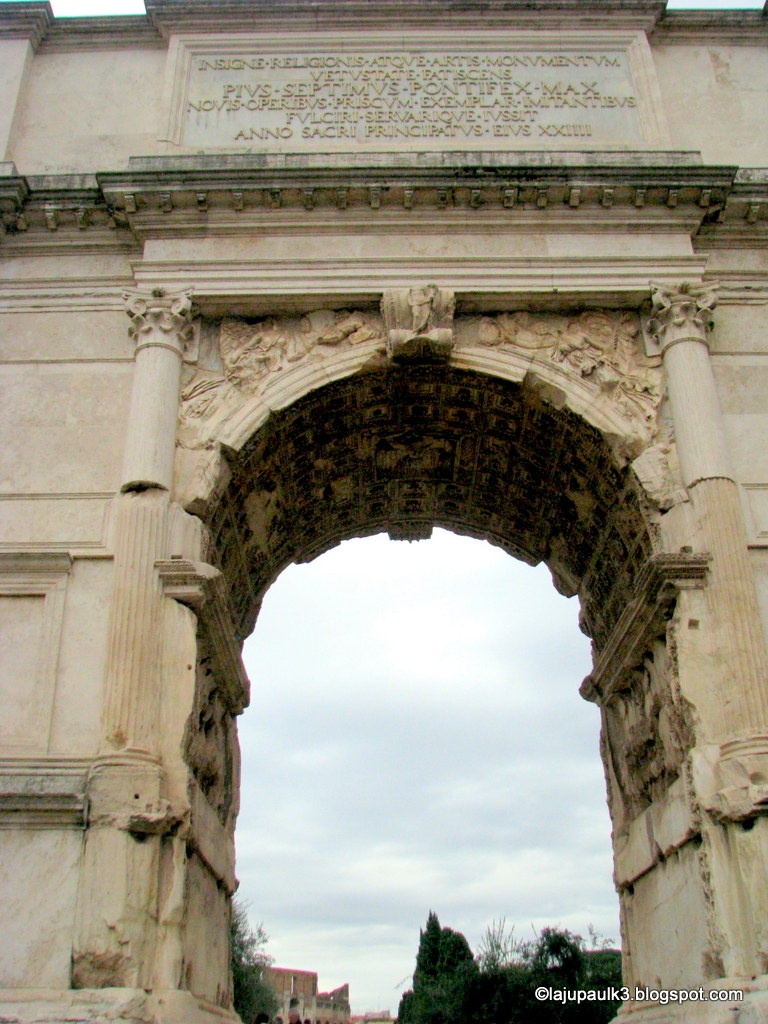
THE 'ARCH OF TITUS' (81 AD), ROME-its Biblical Significance.


The ‘Arch of Titus’ was built in 81 AD by the Roman Emperor Domitian Caesar to commemorate his elder brother Titus Caesar's victories. The monumental arch is 15.4 meters tall, 13.5 meters wide, and 4.75 meters deep, and has three internal panels. The architectural style of the arch is called ‘composite order’. The arch has served as a general model for many of the triumphal arches erected around the world, including the 1806 ‘Arc de Triomphe’ in Paris and the 1931 ‘India Gate’ of New Delhi.

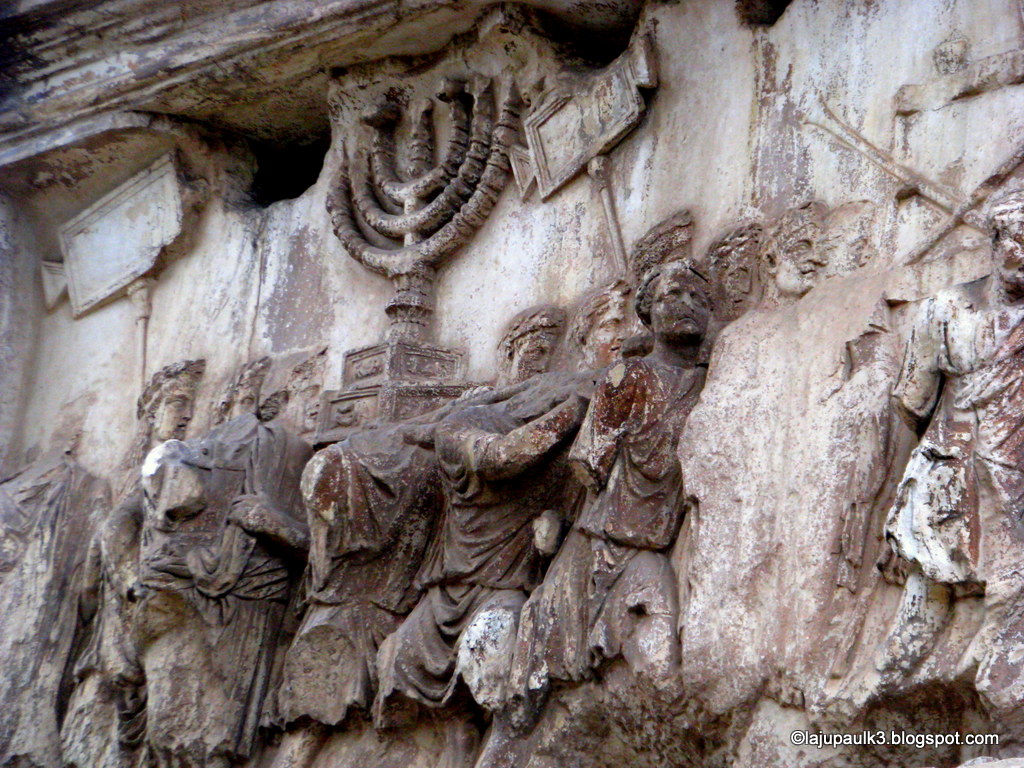
However, the structure’s biblical significance lies with its association to the siege of Jerusalem (70 AD) that marked the beginning of Jewish Diaspora. The event has been symbolically represented with Titus’ triumphal entry into Jerusalem in one of the three panel reliefs of the arch (the other two show Titus’ triumphal ride on a chariot, and his deification). The panel depicts the spoils taken from the ‘Jerusalem Temple’ after it was destroyed by the Roman army under the command of Titus in the first century AD. Many Jews refuse to walk under the Arch of Titus for this reason. However, in 1948 when modern state of Israel was established, the Jews of Rome walked under the arch, but in the opposite direction from that of the conquering Roman army entered the city to symbolize the return of Jews to Jerusalem.

The relief represents Roman soldiers crowned with laurels, carrying the spoils of the Temple of Jerusalem, which are identified as:
1) The two stone law tablets fastened on staffs (the ten commandments of Moses)
2) The golden seven-branched candlestick (menorah)
3) The golden ‘table of showbread’
4) The sacred silver trumpets of Jerusalem Temple.

The first century Jewish historian Flavius Josephus recorded Jerusalem Temple’s sacred treasures, including the menorah being brought to Rome during the triumph of Titus. The current whereabouts of these sacred objects are unknown. There are several interesting legends and conspiracy theories surrounding their current locations. One such candidate is Vatican itself, where some secret chambers are said to secretly hold these sacred treasures. There are even reports about senior Israeli officials, Rabbis and even former Israeli President Moshe Katzav demanding the Pope to return the menorah to Israel!

Until 2009, when the ruins of a synagogue from the Second Temple period (50 BC-100 AD) were discovered in Magdala in Israel, the Arch of Titus preserved the earliest representation of the menorah of the Jerusalem Temple. The menorah depicted on the Arch of Titus served as the model for the menorah used on the official emblem of the modern state of Israel.  

A recent study (The Arch of Titus Restoration Project) undertaken by the New York based Yeshiva University using advanced scanning and spectrometric methods has revealed that the menorah on the Arch of Titus was originally painted in a rich golden yellow colour and the current image faded to the color of its underlying stone long ago. The Bible records the menorah as being made of pure solid gold, and no wonder it was painted in bright yellow in the Arch of Titus that would have looked like gold from far away (see more here).

31 And thou shalt make a candlestick of pure gold: of beaten work shall the candlestick be made: his shaft, and his branches, his bowls, his knops, and his flowers, shall be of the same.
32 And six branches shall come out of the sides of it; three branches of the candlestick out of the one side, and three branches of the candlestick out of the other side:
33 Three bowls made like unto almonds, with a knop and a flower in one branch; and three bowls made like almonds in the other branch, with a knop and a flower: so in the six branches that come out of the candlestick.
34 And in the candlesticks shall be four bowls made like unto almonds, with their knops and their flowers.
35 And there shall be a knop under two branches of the same, and a knop under two branches of the same, and a knop under two branches of the same, according to the six branches that proceed out of the candlestick.
36 Their knops and their branches shall be of the same: all it shall be one beaten work of pure gold.
37 And thou shalt make the seven lamps thereof: and they shall light the lamps thereof, that they may give light over against it.
38 And the tongs thereof, and the snuffdishes thereof, shall be of pure gold.
39 Of a talent of pure gold shall he make it, with all these vessels.
40 And look that thou make them after their pattern, which was shewed thee in the mount.
(Exodus 25:31-40).

The 'Arch of Titus' (81 AD)-Rome.


The inscription 'Senatus Populusque Romanus divo Tito divi Vespasiani filio Vespasiano Augusto' means "The Roman Senate and People (dedicate this) to the divine Titus Vespasianus Augustus, son of the divine Vespasian."


The relief panel on the 'Arch of Titus' (81 AD) depicting the 'Siege of Jerusalem' (70 AD).


The Menorah of Jerusalem Temple depicted on the Arch of Titus (81 AD), Rome. The original colour of the menorah in the arch was bright yellow!


The relief panel depicting Titus' triumphal ride on a chariot. The Arch of Titus, Rome.