Friday, April 4, 2014

30) Remnants of the four Herodian entrances to the Second Jerusalem Temple from the west side. Named after the explorers who worked in Jerusalem in the late 1800s.

It is believed that two of these gates (Wilson's and Robinson's) connected to the surface of the Temple through a tunnel and the remaining two (Warren's and Barclay's) used underground staircases.

Warren's Gate

Wilson's Arch

Barclay's Gate

The yellow arrow marks the original massive lintel (weighs approximately 50 tons) of the Barclay's Gate from first century BC. Above the building right to this lintel is the passage to Mugrabi Gate, the only entrance for non-Muslim's into Temple Mount today. The remaining 10 gates to Temple Mount are accessible only to Muslims.

Robinson's Arch

Sunday, March 30, 2014

21) Four Sephardi Synagogues (16th-18th Century AD), Jewish Quarter. During the 1948 Arab-Israeli War, the synagogues were burnt and used as horse stables by the Jordanians.


Built in 17th century, Yohannan Ben Zakkai Synagogue has two Holy Arks and a Shofar and Oil Jug kept for Prophet Elijah.

Oldest of the four, Eliahu Ha Navi Synagogue was built in 16th century.

Built in mid 18th century in the middle of others, Emtsai or Middle Synagogue is the smallest of the four.

Built in 1760s, Istanbuli Synagogue is the largest and latest of the four.

Replica of the Shofar and Oil Jug for Prophet Elijah to announce and anoint Messiah, kept in the high walls of Yohannan Ben Zakkai Synagogue.

Photos: 5 December, 2008

Friday, March 28, 2014

20) Foundations of the Fortress of Antonia (1st Century BC). One of the possible sites of Pilate's court (Praetorium) where Jesus was judged.


Photos: 18 August, 2009.
Views are from the Temple Mount. Today the foundations are seen underneath the modern Umariya Elementary School in the Old City of Jerusalem.

Tuesday, December 31, 2013

Friday, October 25, 2013

16. The Sanhedrin Tombs (1st century AD).

 Photos: 20 March 2009

Located in the ultra-orthodox Jewish neighborhood of Sanhedriya, these burial niches are often ascribed to the members of the Great Sanhedrin (the 71-membered supreme court of Jerusalem at the time of Jesus)! The graves are also known as “the Tombs of the Judges" and “Tombs of the Righteous”. Although the Sanhedrin tradition is from 15th century AD only, these burial caves are from the Second Temple Period (1st century AD). Today, there are around 80 rock-cut tombs in the complex and most of them lie in a derelict state, or at least that was the case when I visited the site.

Location:
Look for the entrance to 'Sanhedriya Park' on 'Ha Admorim Leiner Street' (near the intersection of Giva'at Moshe and Sderot Golda Me'ir Streets). The Sanhedriya Tombs are scattered inside this small park.

Monday, September 30, 2013

15. The Immovable Ladder of the Church of Holy Sepulcher.

Photos: 10 April, 2009 (Good Friday)

What makes this ordinary looking ladder made of cedar wood so special is that it has remained in this exact spot on the facade of the Church of the Holy Sepulchre for more than 250 years! The earliest known report about the ladder is from 1757 and it has never been moved from this position except on two occasions, both relatively  recently on 1997 and 2009. Wikipedia has more details about the ladder here.

Wednesday, August 28, 2013

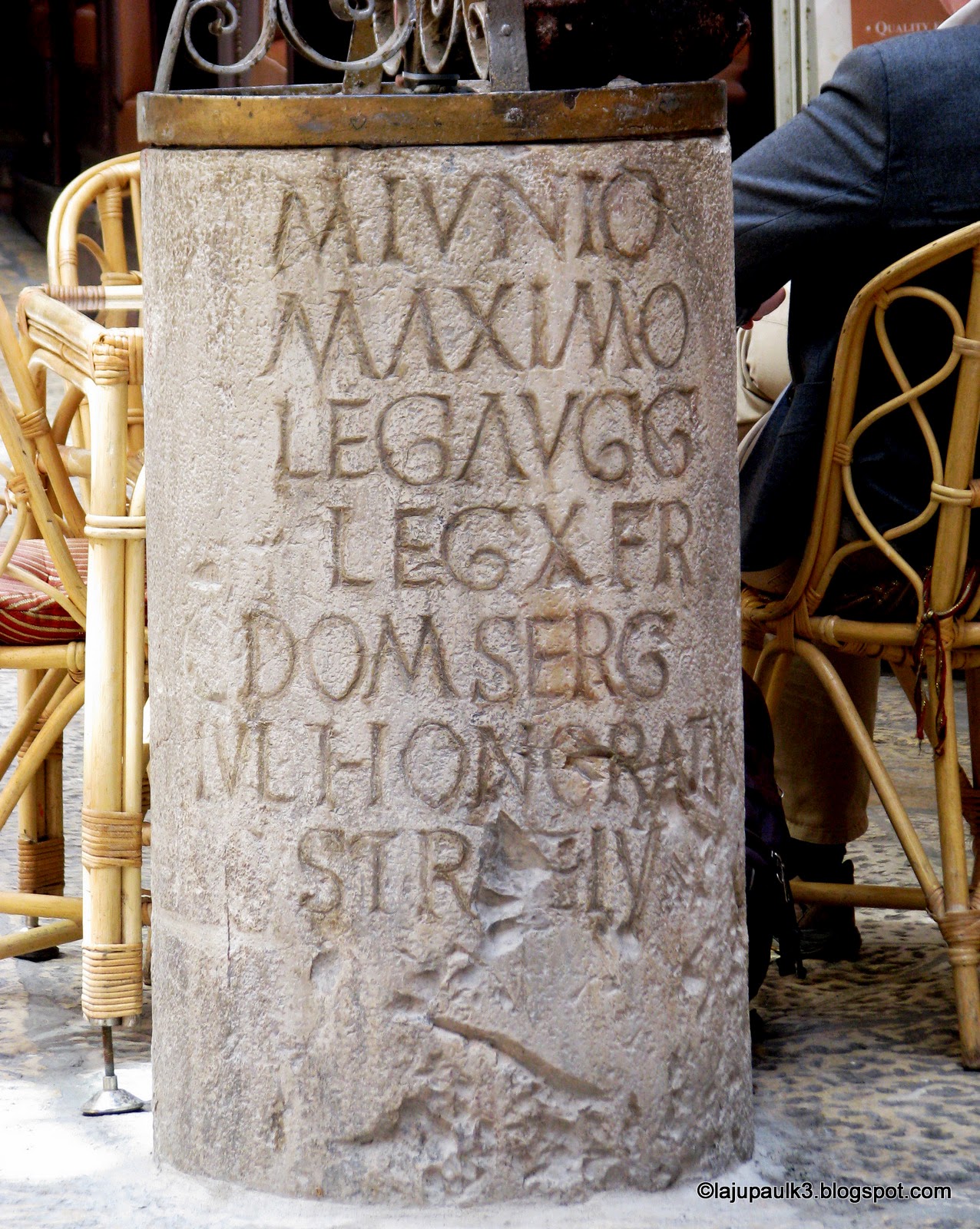
14. Roman Column (1800 years old)-a lamp post for a bar in Jerusalem Old City.

Photo: 7 May, 2010.
This early 3rd century AD Roman triumphant column was discovered in 1885. Today, it serves as a lamp post of a bar in Jerusalem Old City. The Latin engravings on the column are dedicated to Marco Junio Maximo, an emissary of the 10th Legion under the Roman emperor Septimius Severus (145-211 AD). Remember, the same legion under the command of Titus was responsible for the siege and destruction of Jerusalem in the year AD 70. 

Father Jerome Murphy-O'Connor translates the inscription: "M(arco) Iunio Maximo leg(ato) Aug(ustorum) Leg(ionis) X Fr(etensis) Antoninianae C. Dom(itius) Serg(ius) str(ator) eius". He further writes, 'The inscription honours Marcus Iunius Maximus, Legate of the Augusts (i.e. the emperor Septimius Severus and his eldest son Caracalla), which implies that he was the governor of the province of Judaea, and Legate of the Tenth Legion Fretensis. It was erected c.ad 200 by one of his aides, C. Domitius Sergius Honoratus. After participating in the capture of Jerusalem in ad 70, the Tenth Legion was based in the city for over 200 years, occupying the area that is now the Armenian Quartern' (The Holy Land: An Oxford Archaeological Guide from Earliest Times to 1700, 5th Edition, 2007, p.66-67).

Location

The Roman column is located very near Jaffa Gate. Look for the second side street to the Christian Quarter, which is to your left while entering the Old City from Jaffa Gate. A few feet inside the street, you should find 'New Imperial Hotel' or 'Versavee Bistro, Bar & Cafe’; the column is in the middle of their courtyard with a flag/lamp post on top of it advertising ‘Bar & Café’!

Wednesday, July 31, 2013

THROUGH THE LAND OF ISRAEL III-Time for a new avatar?


There was a time when when this blog was uploaded with more than 250 posts per month, and it has declined into a meager 1-2 posts now. The main reason for such a downfall is because I don't live any more in the ’Holy Land’ to walk ’Through the Land of Israel'. Moreover, I didn't want an abrupt ending to the blog. An alternate option for me is to widen the area of exploration outside Israel to Europe with a special emphasis on the Jewish heritage monuments and Holocaust memorials. Since Jewish diaspora in Europe is immensely spread out and my resources and time are limited; I would be most content if at least some of the major Jewish sites in the continent are covered. As a starting step, I am uploading one of our recent adventures in Norway to trace the background of a young Jewish girl Ruth Sakolsky who died in the Auschwitz concentration camp.

The Story of Ruth Sakolsky (1940-1943).