Experience the most vibrant,amazing yet unpredictable strip of land on earth.
Saturday, November 28, 2009
BEIT SHEARIM NATIONAL PARK. A City from 1st Century BC; The Headquarters of Sanhedrin (Supreme Court of Ancient Israel) under Rabbi Yehuda HaNassi.
The UN-protected site of Beit Shearim (The City of Two Gates) is sometimes considered as Israel's equivalent to Petra. Compared to many biblical sites, Beit Shearim is not very ancient. In fact it is not even mentioned once in the Bible. However, this city from 1st Century BC is one of the most impressive dead Jewish city discovered so far. The First Century (AD) Jewish Historian Flavius Josephus mentions the city as "Besara"-a territory belonging to Bernice, the great grand-daughter of King Herod the Great.
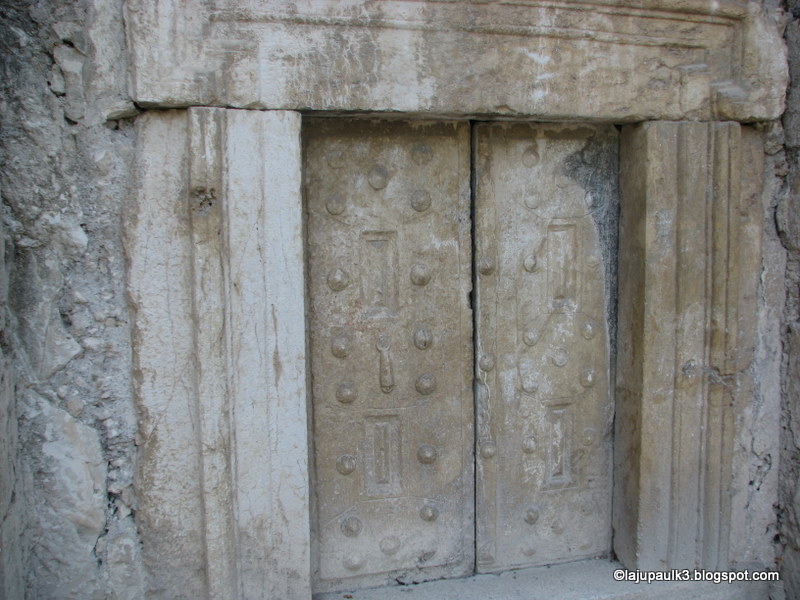
Today, if you visit Beit Shearim, it appears like a city of dead. You can find at least 31 catacombs with hundreds of burial chambers and sarcophagi from 2nd -4th Century AD dispersed everywhere. Some of them family tombs and others are public burial places. The walls of the caves and sarcophagi are decorated with carvings, paintings and engravings of sacred Jewish symbols, diverse geometric designs, figures of humans and animals and even pagan deities. Numerous Hebrew, Greek and Aramaic inscriptions also have been discovered from the catacombs, indicating the strong influence of Jewish and Greek cultures in the region.
The cornerstone and the most important tomb in Beit Shearim is that of the famous Jewish Rabbi from 2nd Cent AD, Rabbi Judah HaNassi. After Judah HaNassi's burial, Beit Shearim became the most sought-after burial place for Jews, many from both Israel and the diaspora desiring to be buried there. Just outside the cemetery of Beit Shearim lies the ancient town of Beit Shearim from Roman Period (2nd Cent 0nwards), on the top and slopes of a hill spread in an area of 25 acres. Beit Shearim was destroyed in a fire in 352 AD, during the Jewish revolt against the Romans. Later, it was renewed as a Byzantine city (5th-6th Cent AD). From the early Arab period (7th century), the city was almost neglected.
An Arab village called Sheikh Bureik was located here in the late 16th century. In 1920, the Jewish National Fund (JNF) purchased the land of Arab village of Sheikh Bureik and in 1936, Alexander Zaid, a watchman of JNF identified and rediscovered ancient Beit Shearim. Today, after series of archaeological excavations, the city and the cemetery of ancient Beit Shearim is carefully preserved under a National Park.
Today, if you visit Beit Shearim, it appears like a city of dead. You can find at least 31 catacombs with hundreds of burial chambers and sarcophagi from 2nd -4th Century AD dispersed everywhere. Some of them family tombs and others are public burial places. The walls of the caves and sarcophagi are decorated with carvings, paintings and engravings of sacred Jewish symbols, diverse geometric designs, figures of humans and animals and even pagan deities. Numerous Hebrew, Greek and Aramaic inscriptions also have been discovered from the catacombs, indicating the strong influence of Jewish and Greek cultures in the region.
The cornerstone and the most important tomb in Beit Shearim is that of the famous Jewish Rabbi from 2nd Cent AD, Rabbi Judah HaNassi. After Judah HaNassi's burial, Beit Shearim became the most sought-after burial place for Jews, many from both Israel and the diaspora desiring to be buried there. Just outside the cemetery of Beit Shearim lies the ancient town of Beit Shearim from Roman Period (2nd Cent 0nwards), on the top and slopes of a hill spread in an area of 25 acres. Beit Shearim was destroyed in a fire in 352 AD, during the Jewish revolt against the Romans. Later, it was renewed as a Byzantine city (5th-6th Cent AD). From the early Arab period (7th century), the city was almost neglected.
An Arab village called Sheikh Bureik was located here in the late 16th century. In 1920, the Jewish National Fund (JNF) purchased the land of Arab village of Sheikh Bureik and in 1936, Alexander Zaid, a watchman of JNF identified and rediscovered ancient Beit Shearim. Today, after series of archaeological excavations, the city and the cemetery of ancient Beit Shearim is carefully preserved under a National Park.
Friday, November 27, 2009
THE CAVE (TOMB) OF RABBI YEHUDA HANASSI (135-219 AD), BEIT SHEARIM. The Compiler or Main Editor of Mishna-Ancient Jewish Texts.
Beit Shearim is one of the most prestigious necropolis (burial ground) in the world from 3rd-4th Century AD. A city with 31 catacombs and hundreds of burial chambers and sarcophagi, tries to tell us that many desired to get buried here. The simple reason is because Beit Shearim is the burial site of Rabbi Judah HaNassi (135-217 AD)-the great Jewish sage who compiled and edited Mishna. If Torah is the 'Written Law' of God, Mishna is the 'Oral Law ' transferred through generations. It was Rabbi Judah HaNassi who first compiled the 'Jewish Oral Law', which later became the base of the voluminous religious sacred texts in Judaism called Talmud. He also established Sanhedrin (Supreme Court of Ancient Israel) in Beit Shearim. For many of these reasons, Rabbi Judah HaNassi is a figure of very high reverence in Judaism.
His burial inspired Jews to be interred like him in Bet Shearim. Although the dream of every Jew was to get buried in the Mount of Olives in Jerusalem; from 2nd Cent onwards, Romans barred Jewish presence in Jerusalem and Beit Shearim became the next best alternative. After Rabbi Judah's death, Bet Shearim became the main site for Jewish burial in Palestine for a period of a hundred years. How do you know that this cave is indeed Rabbi Judah haNassi's burial place? On the walls are written the names of Rabbi Yehuda HaNassi's two sons, Rabbi Gamaliel and Rabbi Shimon in Hebrew and Greek. Together with the Jewish tradition that Rabbi Judah HaNassi was buried in Beit Shearim, this cave is generally accepted as his burial spot.
"THE CAVE OF THE COFFINS" or "THE CAVE OF THE RABBIS", BEIT SHEARIM. The Largest Burial Cave in Beit Shearim.
It is the largest and most interesting of the caves in Beit Shearim. Filled with 135 coffins with all sorts of designs and inscriptions, this cave complex is a must place to visit in Beit Shearim.
Subscribe to:
Posts (Atom)